
Overview#
TIRx (pronounced “tier-ex”) is an open-source, hardware-native DSL and compiler for machine-learning kernels. It targets the part of the AI software stack where fast-moving kernels meet fast-moving hardware: TIRx compiles to GPUs and specialized AI accelerators today and is designed to grow with the hardware generations that follow. The same design makes it a substrate not only for expert-written kernels, but also for agent-generated kernels and megakernel systems.
TIRx is the next-generation kernel-level compiler structure of Apache TVM, and is built on top of the TVM compiler infrastructure.
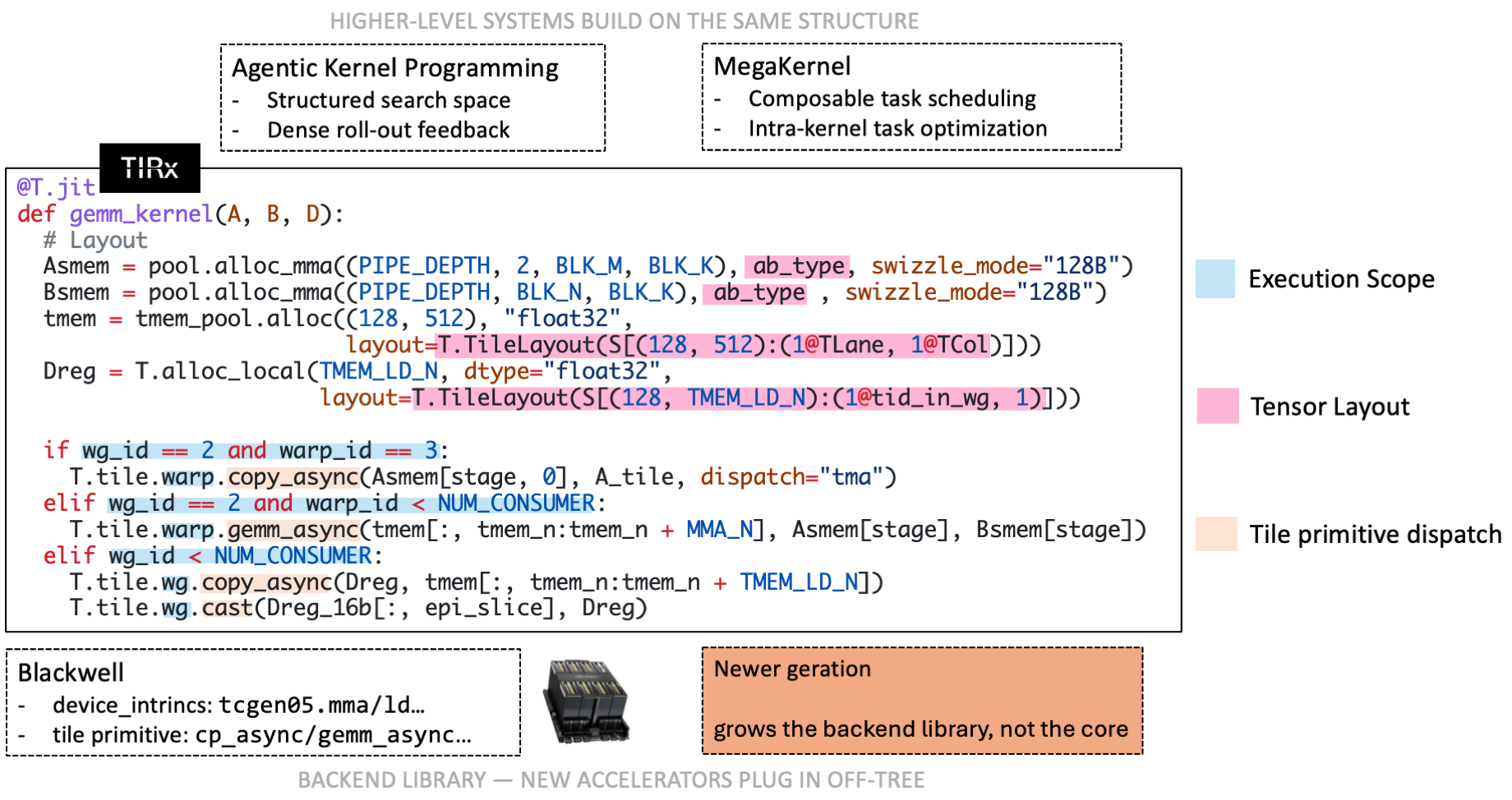
A TIRx kernel keeps orchestration — pipeline state, roles, synchronization, and backend intrinsics — in hardware-native source, while execution scope, tensor layout, and tile op dispatch expose the recurring tile structure to the compiler. Higher-level systems build on the same structure.#
Design Philosophy#
Kernel DSLs are most effective when they choose the right boundary between the programmer and the machine. For mature kernels on mature hardware, that boundary can be high-level: the compiler hides thread assignment, memory movement, layout details, and instruction selection behind compact tensor or tile abstractions, and this works well for established kernel patterns.
At the frontier, the same boundary is under more pressure. New instructions, memory spaces, cooperation patterns, and kernel algorithms often appear before a compiler has enough built-in machinery to automate them well.
TIRx chooses a lower and more explicit boundary. It keeps the parts of a kernel that frequently require expert control — pipeline structure, synchronization, role assignment, memory placement, and backend intrinsics — in hardware-native source code. At the same time, it exposes the recurring tile-level structure to the compiler through three constructs: execution scope, tensor layout, and tile op dispatch. Orchestration stays in hardware-native source code, while the recurring tile-level structure becomes visible to the compiler. Hardware-native control is powerful but costs engineering effort; exposing recurring operations as tile ops relieves this, since authors reuse a dispatched implementation instead of re-writing the same operation for each kernel and backend.
The result is a DSL that can grow with the hardware. A new feature can first be used directly as a native intrinsic, and later become a reusable tile op once the pattern stabilizes. This is the core design philosophy behind TIRx: keep the foundation small and explicit, and let the backend library evolve as new accelerator generations arrive.
The Programming Model#
A TIRx program reads as a structured native kernel: loops, branches, tensors, synchronization, pipeline state, backend intrinsics, and hardware roles are written directly. Tile ops appear exactly where a repeated hardware-level operation should become reusable and dispatchable.
Execution scope#
Execution scope describes both the active participants and the logical scope of
a tile op invocation. Control flow such as if wg_id == ...,
warp_id == ..., or cbx == ... selects which hardware roles enter a
region, while predicates such as Tx.cuda.elect_sync() further select the
issuing lane within each active warp. To obtain one issuer for a wider scope,
first select one warp and then use elect_sync inside it.
Tile ops declare their execution scope explicitly. For example,
scope="warpgroup" selects warpgroup cooperation; scope="thread"
is the default on backend tensor instructions.
Tensor layout#
Tensor layout, with a storage-first interface, describes how logical tensors map to physical resources. A tile may live in global memory, shared memory, per-thread local storage, tensor memory, or accelerator SRAM. Users declare where each tile lives and how its elements are spread across lanes, warps, and per-thread storage elements; tile op lowering uses those declarations to validate operand mappings and generate addresses. A layout is a storage description, not a loop-transformation utility: users may construct a tile’s layout, but never use layouts to transform loops.
See also
The layout model — including the shard / replica / offset structure and its design rationale — is described in Tensor Layout, which also has an interactive explorer.
Tile op dispatch#
Each backend registers lowering implementations for its tile ops. On CUDA, the caller selects an exact PTX instruction, including its qualifiers:
Tx.cuda.tile.apply(Tx.ptx["ld.global.v4.b32"], registers, global_words)
Each instruction defines a canonical operand pattern. The caller prepares
views with the required atom coordinates and repeat axes; lowering checks the
operand shapes, physical layouts, and execution scope, then emits that same
instruction for each repeat coordinate. The caller controls vector width,
matrix shape, transpose mode, temporary storage, and synchronization.
Tx.cuda.tile.ewise repeats a caller-defined scalar function over registers.
Trainium exposes named instruction ops such as load, store,
tensor_copy, matmul, and tensorreduce. Their lowering checks the
instruction’s operand and layout requirements and generates the corresponding
NKI calls.
Putting it together#
Across a full kernel, orchestration stays in ordinary source code, and the
recurring hardware operations appear as tile ops. For the building blocks —
TMA loads, tcgen05 async MMA, Trainium reductions, and the rest — see the
instruction walkthroughs in Tile Operations.
What TIRx Enables#
TIRx is immediately useful as a kernel DSL. The same structure also helps with three things that are becoming important for ML systems: supporting new hardware, building megakernels, and agentic kernel programming.
A stable extension boundary for future hardware#
New hardware support is a staged process rather than a redesign of the DSL: a feature is first exposed as a backend intrinsic, then promoted into a tile op once the usage pattern repeats. Future hardware grows the backend library, not the core language.
Megakernels and composable tile tasks#
Because TIRx tasks exist as compiler IR rather than separately compiled kernels, a megakernel compiler can stitch and schedule them directly — re-offsetting shared memory, renaming barriers, reassigning warp roles, and interleaving pipelines across tasks.
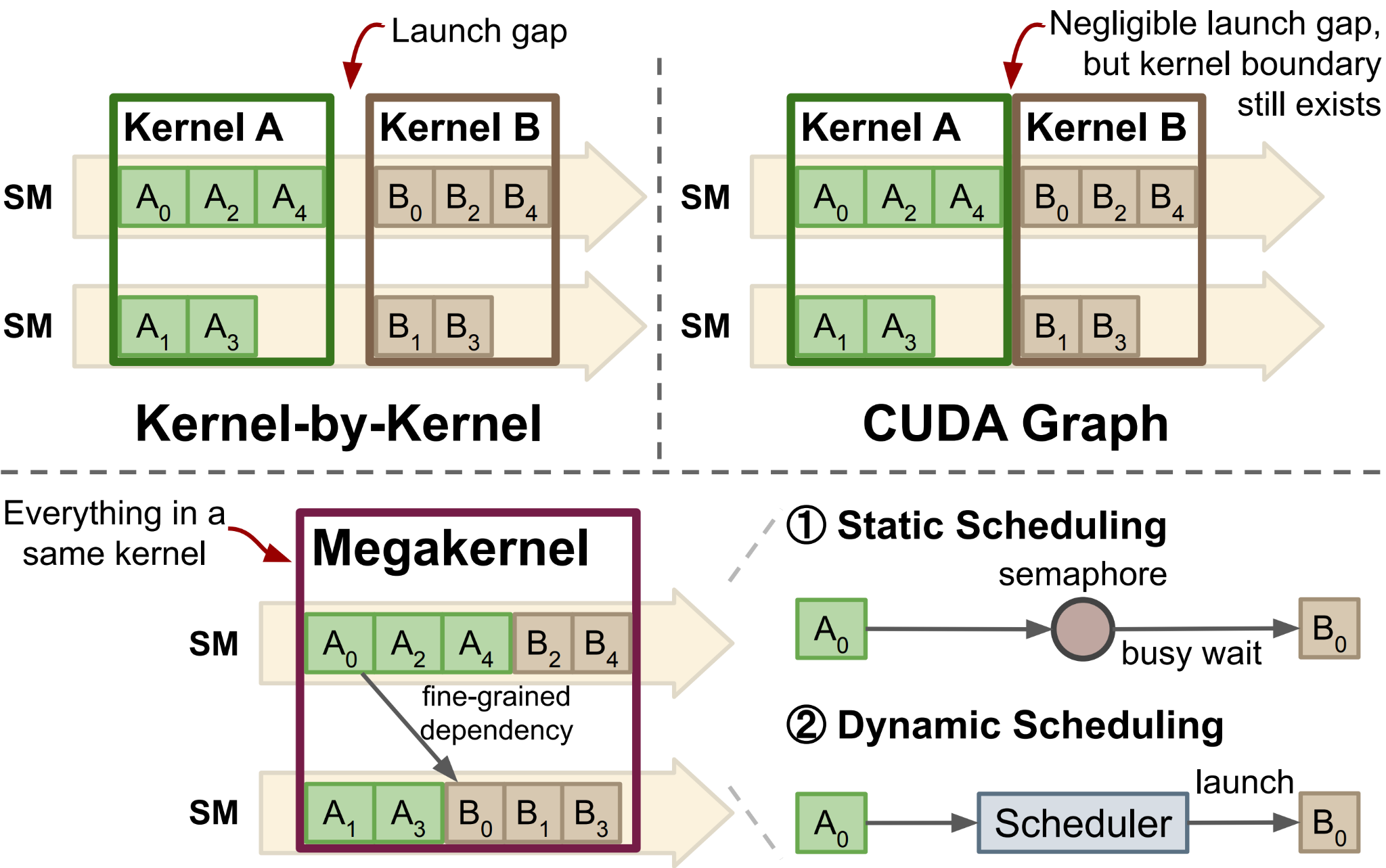
From kernel-by-kernel launches to a single megakernel: fusing tasks into one kernel exposes fine-grained dependencies and in-kernel (static or dynamic) scheduling.#
Agentic kernel programming#
TIRx exposes its IR and compiler utilities through TVM FFI across Python, C++, and Rust. Its structured IR supports inspection and well-formedness checks before a kernel is benchmarked, while target compilation and execution provide the final validation of backend-specific behavior.
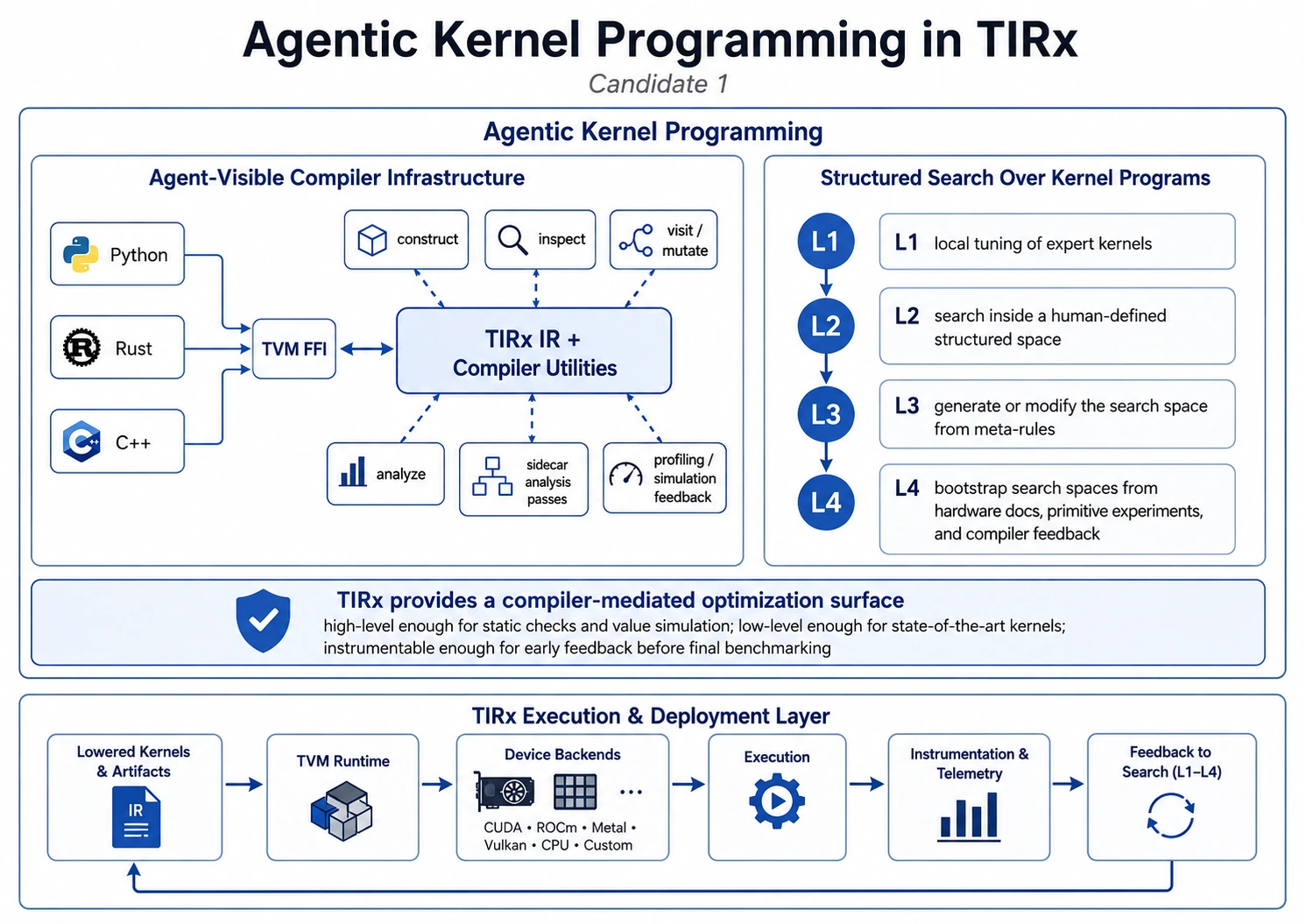
Agent-visible compiler infrastructure (IR and utilities over TVM FFI) plus a structured search space (levels L1–L4) make TIRx a compiler-mediated optimization surface for agents.#
Next Steps#
Installation — install TIRx and the kernel library.
Your first kernel — write and compile a first CUDA kernel.
Programming Guide — the complete programming guide.
Tensor Layout and Tile Operations — reusable tensor and tile abstractions.
Compiler Internals — compiler internals (lowering pipeline, passes, codegen).
API Reference — authoring, IR, compiler, and extension API signatures.